
• ℹ️ Heads up...

    This is a popular topic that is fast moving Guest - before posting, please ensure that you check out the first post in the topic for a quick reminder of guidelines, and importantly a summary of the known facts and information so far. Thanks.

Ride Access Pass and Disabled Access - 2026 Discussion

Where's the "more rides, more shows, more anything" option?

Another sensory area would be ideal given the existing one being in CBeebies Land which I'm sure ends up being a bit awkward for any adults who might need it.

More rides helps the problem but let’s be honest, even if you put an extra 5000 per hour ride capacity on park you won’t make a huge dent in the impact of RAP.

The biggest benefit would be to scrap the annual pass for everyone, but I doubt that would happen with Merlin.
 
But the scrap the passes idea is probably one of the few that would actually work...taking the park straight back to a premium product.

You have budget passholders with their flask of hot dogs, paying a couple of quid entry and car parking (if they are not fiddling that), filling the park.

Stop all passes.
 
But the scrap the passes idea is probably one of the few that would actually work...taking the park straight back to a premium product.

You have budget passholders with their flask of hot dogs, paying a couple of quid entry and car parking (if they are not fiddling that), filling the park.

Stop all passes.
Or have a cap on maximum visits on the passes per year of something like 15, for example. If you want to make your pass unlimited so you can hang around there every single week then it's an extra £300 on top of what you've already paid.
 
Are there really that many people who do hang about that much.

Why not restrict the lower tiers to off peak days and have the most expensive pass weekend and holidays only?

While I do feel something has to change for RAP users the abuse does also need to be tackled.

How about a disability max? So the physical allows 500 people per day and crowds 100. Or as a percentage of predicted park visitors? Therefore your not excluding anyone but you also capping the crowds users who seem to be the issue.

I like that if overstimulation is a triggering part of a disability a theme park is not the right environment for you. It's a place designed to be full of colours, loud noises, lots of movement, fast rides and people packed paths. Maybe a national trust or rspb membership would be more suitable with vast beautiful countryside?

I would not take a vegan to a steak restaurant for them to complain it's just meat available.

It's a delicate balance but merlin is a business and it has many accomodations in place. Your going to impact your standard customer if RAP is left the way it is and the people who are physically unable to stand.
 
How about a disability max? So the physical allows 500 people per day and crowds 100. Or as a percentage of predicted park visitors? Therefore your not excluding anyone but you also capping the crowds users who seem to be the issue.

I like that if overstimulation is a triggering part of a disability a theme park is not the right environment for you. It's a place designed to be full of colours, loud noises, lots of movement, fast rides and people packed paths. Maybe a national trust or rspb membership would be more suitable with vast beautiful countryside?

I would not take a vegan to a steak restaurant for them to complain it's just meat available.

That's what the pre-booking system was for. Capped numbers each day but obviously meant you either had to be right on top of whatever day they randomly opened up certain dates (pre-arranged dates only communicated this year) or just miss out. Was alright for us but for those with more unpredictable issues wasn't ideal.


I really detest this whole "if you find things overstimulating don't go to a theme park" viewpoint. Why should anyone be prevented from doing something they enjoy (especially kids)? Sensory seeking is often a big thing with neurodivergent people and theme parks are a perfect thing for this.

It's 2026. It's not beyond the possibility that places can provide reasonable adjustments as necessary. On top of whatever steps said person might do to help themselves (like ear defenders).
 
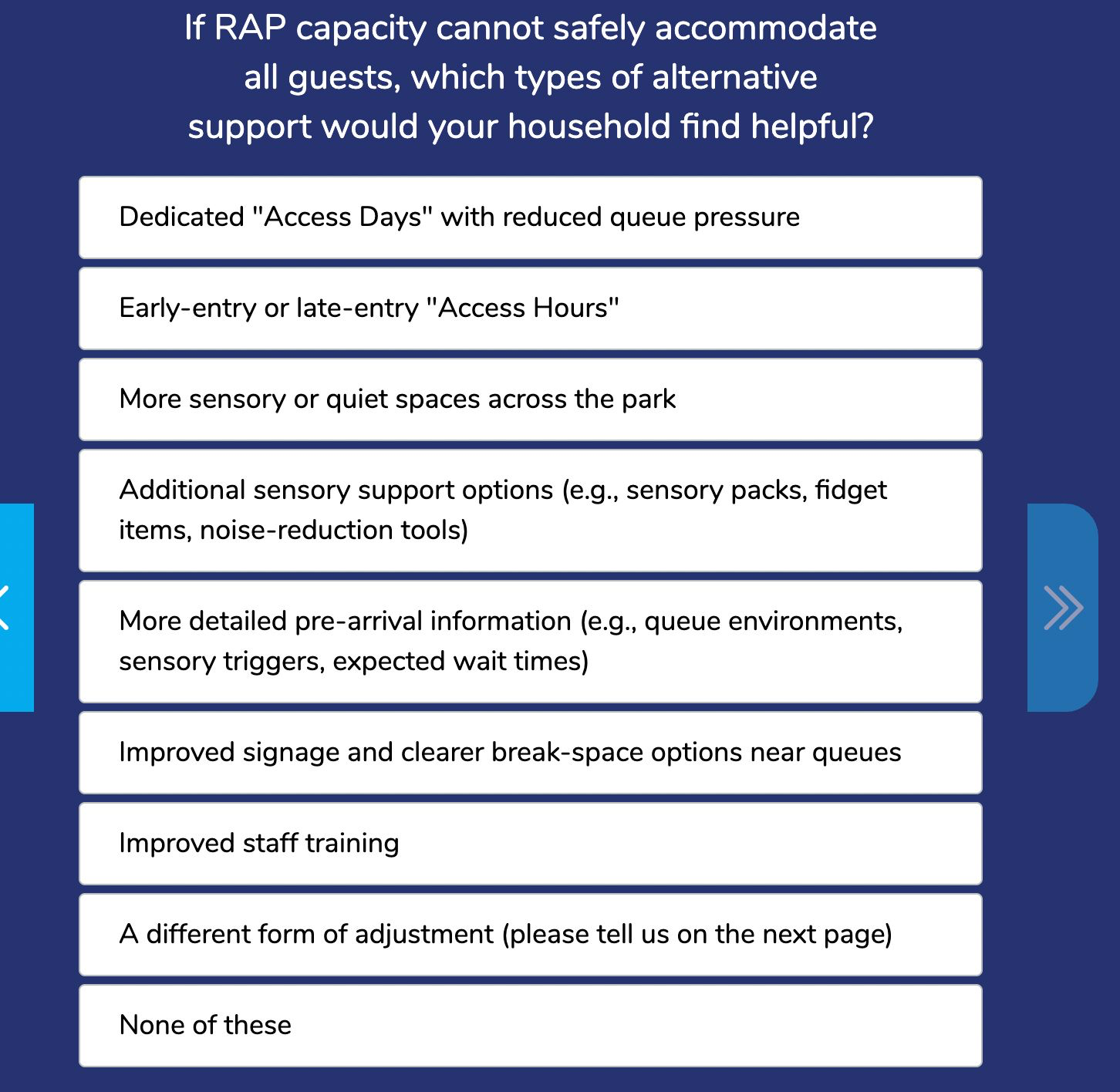
I did the survey, it was quite interesting.

The main questions of note were:

- "If you could suggest one realistic improvement to support your family on future visits what would it be?"
- "Are there particular attractions, queue layouts or environments where you feel additional support would make the biggest difference?"


And this one which i thought was easier to screenshot:

bkA7w.png
This is an interesting one because it’s very much a “ok, you think you know better so let’s see”.

If the queue lines were long enough that you never stopped moving it might go some way to improving things. Plus the Wicker Man merge point-anteroom-batching station is the worst designed thing for anyone with even a modicum of sensory issues I’ve ever experienced.
 
I really detest this whole "if you find things overstimulating don't go to a theme park" viewpoint. Why should anyone be prevented from doing something they enjoy (especially kids)? Sensory seeking is often a big thing with neurodivergent people and theme parks are a perfect thing for this.
I think that the problem is people who do not live with these conditions do not understand the whole concept. The inability to deal with crowds doesn't mean that being in close sudden contact with a dozen people leads to a meltdown, it's way more complex than that. Being in a busy area where it's outdoors, people are moving and for relatively short periods of time is totally different to being in a restricted, slow moving space for long periods of time. At Alton Towers and other theme parks, they are such huge spaces that other than areas immediately outside big rides it's rarely shoulder to shoulder.

I received the Merlin survey email on RAP this morning, I notice their remedy choices for neurodiverse families to choose from do not include 'leave it as it is' as a choice. They seem determined to fix the problems with quiet spaces and more information for guests which I think means that they fundamentally do not understand the conditions they're dealing with. From the press statements they have made it is clear that they have in their heads that only those persons with a physical impairment can be considered disabled, which is a very activist view promoted by a minority. They need to look at the criteria around ability to queue, not this new presumption that everyone with Autism just needs to wear headphones and given a timeout space to be OK. Their rules always used to have that as the primary requirement but their own staff used to ignore them which has allowed RAP to get out of control...
 
This is an interesting one because it’s very much a “ok, you think you know better so let’s see”.

If the queue lines were long enough that you never stopped moving it might go some way to improving things. Plus the Wicker Man merge point-anteroom-batching station is the worst designed thing for anyone with even a modicum of sensory issues I’ve ever experienced.

That’s pretty much what i said in my reply.

Realistic improvement would be to reduce queue times overall. The main barrier to people accessing them in my opinion is the length of time spent in them. I absolutely guarantee that if in a fantasy world no queue was longer than say 20 minutes, the vast majority of RAP users would have no issue accessing them.

My suggestion to them to achieve this was a combination of changes such as increased entry fees, reduction in annual passes, improved ride availability through investment, increase in alternative attractions such as shows and walkthroughs and addition of higher capacity rides (hello Chessington). The common link with all these is CAPACITY. These are realistic but i appreciate for a company that prioritises profit over experience they might disagree as it is a fundamental change in their business model.

In terms of specific environments i cited rides like Hyperia which feature slow moving cattle pens in incredibly loud surroundings due to the location. This creates a combination of adversities. Again, if a queue moves regularly and more quickly, more people who struggle with things like sensory issues/toilet needs are able to tolerate them if they're for shorter periods. Not everyone but more and that's the point, you want to reduce the number of people requiring alternative accessibility.
 
I’m not sure capacity is the sole factor, though, as parks like Blackpool can also have long and slow-moving queues on peak days, yet RAP never exploded there to the same degree.

You also have parks abroad like PortAventura that are renowned for markedly longer and slower queues than Merlin’s (I do think the direness of PortAventura’s operations is pretty overstated myself, but that’s not the point) that do not have nearly the same issues with RAP.

Disney and Universal also have long (albeit fast-moving) queues, and have never had the same issues with RAP as Merlin.
 
I think that the problem is people who do not live with these conditions do not understand the whole concept. The inability to deal with crowds doesn't mean that being in close sudden contact with a dozen people leads to a meltdown, it's way more complex than that. Being in a busy area where it's outdoors, people are moving and for relatively short periods of time is totally different to being in a restricted, slow moving space for long periods of time. At Alton Towers and other theme parks, they are such huge spaces that other than areas immediately outside big rides it's rarely shoulder to shoulder.

I received the Merlin survey email on RAP this morning, I notice their remedy choices for neurodiverse families to choose from do not include 'leave it as it is' as a choice. They seem determined to fix the problems with quiet spaces and more information for guests which I think means that they fundamentally do not understand the conditions they're dealing with. From the press statements they have made it is clear that they have in their heads that only those persons with a physical impairment can be considered disabled, which is a very activist view promoted by a minority. They need to look at the criteria around ability to queue, not this new presumption that everyone with Autism just needs to wear headphones and given a timeout space to be OK. Their rules always used to have that as the primary requirement but their own staff used to ignore them which has allowed RAP to get out of control...

I assume leave it as it is is not an option because it isn’t working.

Before restricted pre-book the queues for RAP where huge and the normal queue moved at a glacial pace (everyone else also has a right to ride more than one coaster when they have forked out £40 to come). After restricted bookings lots of genuine RAP users couldn’t get tickets.

So yeah I don’t see how “keep it as it is” becomes an option.
 
I’m not sure capacity is the sole factor, though, as parks like Blackpool can also have long and slow-moving queues on peak days, yet RAP never exploded there to the same degree.

You also have parks abroad like PortAventura that are renowned for markedly longer and slower queues than Merlin’s (I do think the direness of PortAventura’s operations is pretty overstated myself, but that’s not the point) that do not have nearly the same issues with RAP.

Disney and Universal also have long (albeit fast-moving) queues, and have never had the same issues with RAP as Merlin.

It's hard for me to personally compare all these.

I've not been to Blackpool in 30 years but from what i've seen the pass only allows +1 and you have to pay for extras so this is a natural capacity reduction of sorts and could be something Merlin introduces. I also wonder if Blackpool overall has higher capacity in terms of operating attractions to ratio of visitors than the Merlin parks? And finally, queue-time data has average queues lower than any Merlin park so again that goes back to my point about shorter queues meaning less accessibility requirements.

PortAventura again i've not visited in 30 years but i expect the main difference there will be cultural, both in terms of RAP eligibility and the often cited queue jumping. People won't fraudulently bother with a RAP system if they can simply jump the queue. I know in terms of eligibility they have a level system where you must medically have evidence of "33% or more" disability though i've no idea how that works in practice. I also wonder if the cultural differences extend to not wanting to "beat the system" like in the UK or more care for not further disadvantaging the disabled.

Disney and Universal in the US have definitely had the same level of issues though which have been well documented with various changes to their systems though the nature of the issues are not identical to the UK.

I assume leave it as it is is not an option because it isn’t working.

My issue is they simultaneously have made multiple changes to the system without seeing the outcome of one first.

- New monthly slot release
- New digital onsite system
- New eligibility criteria

It would have been more prudent to have introduced perhaps the first two changes and to see if that improved things. But if they have the data that shows that demand absolutely dwarfs availability then i can understand why they've gone for a drastic overhaul.
 
It's hard for me to personally compare all these.

I've not been to Blackpool in 30 years but from what i've seen the pass only allows +1 and you have to pay for extras so this is a natural capacity reduction of sorts and could be something Merlin introduces. I also wonder if Blackpool overall has higher capacity in terms of operating attractions to ratio of visitors than the Merlin parks? And finally, queue-time data has average queues lower than any Merlin park so again that goes back to my point about shorter queues meaning less accessibility requirements.

PortAventura again i've not visited in 30 years but i expect the main difference there will be cultural, both in terms of RAP eligibility and the often cited queue jumping. People won't fraudulently bother with a RAP system if they can simply jump the queue. I know in terms of eligibility they have a level system where you must medically have evidence of "33% or more" disability though i've no idea how that works in practice. I also wonder if the cultural differences extend to not wanting to "beat the system" like in the UK or more care for not further disadvantaging the disabled.

Disney and Universal in the US have definitely had the same level of issues though which have been well documented with various changes to their systems though the nature of the issues are not identical to the UK.


My issue is they simultaneously have made multiple changes to the system without seeing the outcome of one first.

- New monthly slot release
- New digital onsite system
- New eligibility criteria

It would have been more prudent to have introduced perhaps the first two changes and to see if that improved things. But if they have the data that shows that demand absolutely dwarfs availability then i can understand why they've gone for a drastic overhaul.

I was talking about the questionnaire, yes the implementation of this recent change has been farcical even if I agree with it.
 
The last time I used the Blackpool system it was plus one free, but you could add two more on for a fiver each...
So not "free fasttrack" as such, but two fasttracks for a tenner, all day.
Didn't use it last year, so it may have changed.
And Matt, it has become more of a problem with each year, Avalanche queue in particular just ground to a halt with trains full of fasttrack and their rap taking every other full train.
 
It's hard for me to personally compare all these.

I've not been to Blackpool in 30 years but from what i've seen the pass only allows +1 and you have to pay for extras so this is a natural capacity reduction of sorts and could be something Merlin introduces. I also wonder if Blackpool overall has higher capacity in terms of operating attractions to ratio of visitors than the Merlin parks? And finally, queue-time data has average queues lower than any Merlin park so again that goes back to my point about shorter queues meaning less accessibility requirements.
I’ll admit to not knowing specifics about Blackpool’s pass, but what I can say is that their attraction throughputs tend to be markedly lower than Merlin’s, as much as they have more attractions. Big coaster throughputs in Blackpool tend to be quite sluggish compared to those at Alton and Thorpe, from my experience.

As for the queues averaging less, I’d hazard a guess that this might be in part due to Blackpool being more seasonally affected than the Merlin parks, being in a summer holiday destination and having its success somewhat intrinsically tied to that of the town it sits in to an extent. Slightly anecdotal, I know, but I’ve been to Blackpool on a peak day and waited 2 hours for Valhalla and 80 minutes for Nickelodeon Streak before, and I’ve heard similar tales from others on peak days.

I also don’t buy that Merlin park operations and queues are half as bad as many on here make out. Yes, they’re not quite as lightning fast as Europa Park, but at Alton Towers and Thorpe Park at least, rides generally run on full capacity and dispatch trains promptly, and you don’t tend to have multiple queues exceeding 60 minutes other than on extremely peak days.
 
you don’t tend to have multiple queues exceeding 60 minutes other than on peak days.

Most people visit on peak days though, that's why they have the name :D

Anyone with children is visiting almost exclusively on peak days. Their real life experience is only seeing the parks as you describe them. You only have to go on social media in the school holidays or especially Halloween for the screenshots of queue times. This is what makes it impossible for those requiring a RAP to otherwise visit (unless they are able to purchase a Fast Track). I suppose we could start means testing RAP users in this regard but i can't imagine that would be particularly well received!


F06q7SnXwAIkvPc
 
Most people visit on peak days though, that's why they have the name :D

Anyone with children is visiting almost exclusively on peak days. Their real life experience is only seeing the parks as you describe them. You only have to go on social media in the school holidays or especially Halloween for the screenshots of queue times. This is what makes it impossible for those requiring a RAP to otherwise visit (unless they are able to purchase a Fast Track). I suppose we could start means testing RAP users in this regard but i can't imagine that would be particularly well received!


F06q7SnXwAIkvPc
Halloween is a particularly extreme end of “peak day”, though. October half term is notoriously the busiest time of year, which is an unfair outlier to use if wanting to portray the “normal” weekend or holiday experience.

People with children can go on weekends outside of the school holidays, or in the school holidays outside of the peak October half term period. You cannot go in what is notoriously the busiest period of the year and expect a seamless experience with many, many rides. Extrapolating the queue times at Alton on Halloween as the “regular” experience is like taking the queue times at Europa Park on Ascension Day (also notoriously busy) as the “regular” experience, which just isn’t the case.

I went in the summer holidays this year, didn’t queue longer than 35 minutes for anything, and didn’t see an advertised queue longer than 45 minutes. That was a peak period, but I did not have this hideous 60+ minute queues across the board experience that you describe, and many others didn’t have this experience over the summer either.

I don’t buy this narrative you sell that there are always 60+ minute queues across the board on any day other than an off-peak weekday. On most regular weekends or holiday days, I would say multiple queues above 60 minutes is a rare occurrence. October half term is an outlier rather than the normal experience as you’re trying to make out.
 
That’s pretty much what i said in my reply.

Realistic improvement would be to reduce queue times overall. The main barrier to people accessing them in my opinion is the length of time spent in them. I absolutely guarantee that if in a fantasy world no queue was longer than say 20 minutes, the vast majority of RAP users would have no issue accessing them.

My suggestion to them to achieve this was a combination of changes such as increased entry fees, reduction in annual passes, improved ride availability through investment, increase in alternative attractions such as shows and walkthroughs and addition of higher capacity rides (hello Chessington). The common link with all these is CAPACITY. These are realistic but i appreciate for a company that prioritises profit over experience they might disagree as it is a fundamental change in their business model.

In terms of specific environments i cited rides like Hyperia which feature slow moving cattle pens in incredibly loud surroundings due to the location. This creates a combination of adversities. Again, if a queue moves regularly and more quickly, more people who struggle with things like sensory issues/toilet needs are able to tolerate them if they're for shorter periods. Not everyone but more and that's the point, you want to reduce the number of people requiring alternative accessibility.
Insofar as it’s possible to have a “good” queue experience I always think TCAAM is an example of this. I know the ride is a capacity monster but the even though the queue line is long there’s something to see all the way round it with the graves/easter eggs, dolls etc and then you get the mini preshow diorama.

Really I think this is something that’s nigh on impossible to solve with a one size fits all tickbox exercise like what goes on now. There’s too many variants of disability, neurodivergence and whatnot to be able to apply a single criteria. I’m not sure if this is a shortfall of Nimbus or Merlin but it’s certainly a tricky situation.
 
Top