• ℹ️ Heads up...

    This is a popular topic that is fast moving Guest - before posting, please ensure that you check out the first post in the topic for a quick reminder of guidelines, and importantly a summary of the known facts and information so far. Thanks.

Ride Access Pass and Disabled Access - 2026 Discussion

What ever happened to people wanting to be treated like everyone else in society and not made to feel like they are different? Funny how quickly that goes out of the window for somebody who could queue but they'd rather avoid a 2hr wait for the Smiler.

I really hope Merlin hold firm but from the reaction that the Nimbus team have had, i wouldn't hold my breath. I sense a dramatic U-Turn coming in March.

I'm utterly sick to death about reading about anxiety attacks over last few days too. If your anxiety is that bad then maybe visiting a place that attracts up to 20,000 visitors a day, and has rides specifically designed to increase your stress and anxiety levels, isn't the best place for you. Be like somebody who suffers from severe vertigo but goes climbing mountains every weekend.

Make it make sense for the love of good.

The community here has kept this complex, sensitive topic surprisingly civil over the past week, despite a range of often conflicting perspectives. I've personally noticed an uptick in your contributions in recent years across a number of threads that I find lacking in empathy or understanding, so I'll be muting you going forward. But I'd ask you to investigate why you are so personally invested in these relatively fringe issues to the point of feeling "utterly sick to death about reading about anxiety attacks", or pulling absolutely paper-thin fallacies out of thin air, like that which you open the recent post with.

The majority of people here believe that the current RAP system is being abused by some users, as well as mismanaged by Merlin, so it's not as if you're laying down some uncomfortable truth with posts like this. You're just adding your own ignorance to an otherwise reasonable discussion, one that is largely based on facts and evidence from those who might actually benefit from the system, were it to function as it should.

And while we're at it, surprise surprise, vertigo manifests itself differently on a case-by-case basis, too. If you have a peripheral form of vertigo, you might struggle without some CBT, but Central vertigo doesn't necessarily physically affect your ability to climb mountains. :blush:
 
Last edited:
The community here has kept this complex, sensitive topic surprisingly civil over the past week, despite a range of often conflicting perspectives. I've personally noticed an uptick in your contributions in recent years across a number of threads that I find lacking in empathy or understanding, so I'll be muting you going forward. But I'd ask you to investigate why you are so personally invested in these relatively fringe issues to the point of feeling "utterly sick to death about reading about anxiety attacks", or pulling absolutely paper-thin fallacies out of thin air, like that which you open the recent post with.

The majority of people here believe that the current RAP system is being abused by some users, as well as mismanaged by Merlin, so it's not as if you're laying down some uncomfortable truth with posts like this. You're just adding your own ignorance to an otherwise reasonable discussion, one that is largely based on facts and evidence from those who might actually benefit from the system, were it to function as it should.

Sorry you feel that way but that's your prerogative of course, so mute away.

Just remember though......it isn't people like me either who have been making life harder at Merlin Parks for people who depend on this pass. In fact it's people like me who are being driven away because we've got thousands of people with a sense of entitlement.
 
Last edited:
I can't speak for others, but I don't "believe" RAP is being abused, I know it is. I have had people, friends even, proudly tell me to my face that they are abusing it, simply because they can. One person I know qualified because they were dyslexic. Please tell me how that means they cannot queue?
 
I can't speak for others, but I don't "believe" RAP is being abused, I know it is. I have had people, friends even, proudly tell me to my face that they are abusing it, simply because they can. One person I know qualified because they were dyslexic. Please tell me how that means they cannot queue?

Dyslexia alone doesn't but this is the chickens coming home to roost for Merlin farming out eligibility to Nimbus who were problematic from the offset. They were not set up to specify theme park criteria, they were providing Access cards for a broad range of circumstances so understandably never had any considerations for the impact of capacity on locations that would be using their system. "You get a card, you get a card, everybody gets a card".

I recall pointing out how flimsy their eligibility system was at the time and we subsequently had several TS members test the system to see if they would qualify despite not requiring a RAP. Lo and behold they did and thus the system became reliant on the honesty of applicants which was always doomed to fail.

Of course i understand why Merlin no longer wished to have the responsibility of defining eligibility but they were simply kicking the can down the road. The lack of foresight to see where things were heading was poor.
 
I can't speak for others, but I don't "believe" RAP is being abused, I know it is. I have had people, friends even, proudly tell me to my face that they are abusing it, simply because they can. One person I know qualified because they were dyslexic. Please tell me how that means they cannot queue?

Someone diagnosed with dyslexia alone shouldn't be using the RAP system, obviously. For reference, as I've posted previously in the thread, I have ADHD, diagnosed fairly recently and relatively late in life. I do not, and would not under any circumstances, use RAP, regardless of queue length. This is because it does not cause unmanageable discomfort when queueing, and also because my sad, geeky knowledge of Merlin's shortcomings means I'm aware that the system is not fit for purpose.

My personal issue as this conversation develops is with some of the somewhat unthinking and occasionally straight-up toilet-cubicle-wall-tier rubbish being posted, which invalidate or undermine the complex realities and challenges of life on the neurodivergent spectrum, realities that are more of a lived experience for many here.

In the past two pages alone, posters have advocated that people with anxiety shouldn't visit Alton Towers, or that children with neurological issues might be best off being forced to queue for their own benefit. It begs the question, what if I had been born two or three decades later? Would I now be a raging RAP user? Did having no option but to queue as a child at Alton Towers "toughen me up"... We'll never know, as my parents used to just take me out of school for the day to visit when nobody else was able to go. After all, it was the glorious nineties! :sweatsmile:
 
Last edited:
Someone diagnosed with dyslexia alone shouldn't be using the RAP system, obviously. For reference, as I've posted previously in the thread, I have ADHD, diagnosed fairly recently and relatively late in life. I do not, and would not under any circumstances, use RAP, regardless of queue length. This is because it does not cause unmanageable discomfort when queueing, and also because my sad, geeky knowledge of Merlin's shortcomings means I'm aware that the system is not fit for purpose.

My personal issue as this conversation develops is with some of the somewhat unthinking and occasionally straight-up toilet-cubicle-wall-tier rubbish being posted, which invalidate or undermine the complex realities and challenges of life on the neurodivergent spectrum, realities that are more of a lived experience for many here.

In the past two pages alone, posters have advocated that people with anxiety shouldn't visit Alton Towers, or that children with neurological issues might be best off being forced to queue for their own benefit. It begs the question, what if I had been born two or three decades later? Would I now be a raging RAP user? Did having no option but to queue as a child at Alton Towers "toughen me up"... We'll never know, as my parents used to just take me out of school for the day to visit when nobody else was able to go. After all, it was the glorious nineties! :sweatsmile:

Deliberately misquoting people now too (surprise surprise) ;)

What I actually said was "If your anxiety is that bad then maybe visiting a place that attracts up to 20,000 visitors a day, and has rides specifically designed to increase your stress and anxiety levels, isn't the best place for you".

You see this is the problem when you jump on a high horse. You get knocked off.
 
Deliberately misquoting people now too (surprise surprise) ;)

What I actually said was "If your anxiety is that bad then maybe visiting a place that attracts up to 20,000 visitors a day, and has rides specifically designed to increase your stress and anxiety levels, isn't the best place for you".

You see this is the problem when you jump on a high horse. You get knocked off.

Fair enough, I should have been more accurate in my quoting. But I'd still maintain that most of your contributions to this thread have followed a pattern of misunderstanding or presumption regarding the realities of neurodivergence. And while I don't need a RAP, my own recent experience of diagnosis has forced me to confront my own history of 'masking' in order to be "treated like everyone else in society and not made to feel like they are different", as you put it.

The reality is that this is an exhausting process. And in my opinion, anybody contributing to the particular topic should exhibit appropriate care.
 
If your anxiety is that bad then maybe visiting a place that attracts up to 20,000 visitors a day, and has rides specifically designed to increase your stress and anxiety levels, isn't the best place for you
Neurodiversity doesn’t work like that

When ND people struggle in queues (which are different to crowds), it can often cause physical issues. They don’t just “get fed up waiting” - they physically feel anxious about queuing. For me, it anxiety that I will miss out. For others it manifests in other ways. Very often the problem isn’t the crowd, but could be being stuck. It could be having nothing to do for an hour. It could be needing to run around and spend that built up energy but being unable to because of the 2 meter high fence in the way. The meltdowns and anxiety attacks you refer to are the visible consequences to this pain

You don’t “get used to it”. You never “grow out of it”. No amount of being taken out of the queue and being told that if you can’t behave yourself you can’t ride will help. All that does is cause shame. Someone might _appear_ to have leaned to queue but all they’ve done is learn to mask: which can be seen as a form of self-sabotage in an attempt to fit in because society won’t accept neurodiversity for what it is

To return to your “maybe a theme park isn’t the best place for you” comments I’ve seen a lot: theme parks are absolutely some of the best places to be if you’re neurodivergent. (Predictable!) loud noises can be fun! Rollercoasters and rides give you vestibular sensory sensations safely in a way you often can’t. The rides and areas are bright and colourful, and the storytelling is magical. And best of all, you get to meet and hug Bluey who you like to watch again and again and again on the telly

Theme parks are amazing places for people with autism and adhd
 
Fair enough, I should have been more accurate in my quoting. But I'd still maintain that most of your contributions to this thread have followed a pattern of misunderstanding or presumption regarding the realities of neurodivergence. And while I don't need a RAP, my own recent experience of diagnosis has forced me to confront my own history of 'masking' in order to be "treated like everyone else in society and not made to feel like they are different", as you put it.

The reality is that this is an exhausting process. And in my opinion, anybody contributing to the particular topic should exhibit appropriate care.

You're obviously very angry with me but I dont hold grudges so its all good and im not easily offended anyway.

But believe me when I say this......Im fully behind the use of a RAP and people who genuinely need it. I think its an absolute god send to some people and id never want to see that taken away. But common sense has now got to come into the thinking more rather than fearing upsetting some folk ultimately.

Merlin need to hold firm but they wont.
 
I have spent my whole life trying to avoid overwhelming crowds and busy environments. I don't go to the supermarket at the weekend, I get my food delivered. I don't go to popular attractions on Saturdays or in the school holidays, we take a day off work and go on a quiet day. When I was a child, we exploited off peak days at theme parks as well. My Dad and I had Legoland passes: rather than trying to visit on a Saturday he would pick me up after school and we'd have a nice evening there between 4-7pm (you could do that back then!). When we went to Disneyland Paris, my parents forked out for onsite hotels so we could enjoy our favourite rides during the hotel guests' exclusive ERT. For the rest of the day, we were smart with farming shorter queues by having meals at weird times. My parents didn't agree with taking me out of school but if that's what parents are doing these days to give their kids a nice day out then who's to argue with that?

I still book my holidays at weird times and I'll tend to avoid trying to do anything in August at all as it's usually just not that enjoyable. I'd rather go when it's quiet, of course. But I do have the tools to cope if I get to a theme park and I've horribly misjudged the crowd levels, because my parents didn't demand special treatment for me. They made it as easy as possible to blend enjoyment with developing life skills by being creative and pragmatic.

Again, before anyone jumps down my throat and calls me ableist, I'm just speaking from one perspective. There are lots of kids out there who won't be able to get to that point. That's why Merlin's attempt to tarnish everyone with the same brush is a mistake. But you cannot have thousands of people like me who don't really need a pass being able to qualify based on a diagnosis and using it because they can and it's nicer not to queue. If they'd not been given special treatment in the first place, they'd be fine with going on quieter days, farming short queues and maybe evening faking a cheeky sick day to have a nice day out.
 
As a family who are RAP users (entitled to 2 RAP cards but we only ever applied for 1 at any time), I can say we have seen families with multiple RAP cards in the queue with us openly using/abusing them. In fact for some of them their children were openly all displaying their RAP cards in Lanyards round their neck so there can be no way that the ride operators could not have known that multiple timecards were being used.

But my point all along has been that it is not the condition per-se that was the issue, I used to see time and again Merlin's own staff issuing RAP cards to people against their own rules. For us, we have always had medical reports and letters from my sons consultant specifically saying that he should not queue for long periods of time. That is very different to someone 'just' having a condition which automatically entitles them to an access pass. My daughter suffers from Anxiety (thanks to Covid) and it never even occurred to that she could be entitled to apply for a RAP card, and if I had I wouldn't have dreamt of getting her one anyway.

Merlin moved the problem to Nimbus, and again the issue seems to be a lack of proper policing of actual need before issuing a card, if they did then I do not think we would be in this mess. If I were being cynical I could suggest that it is to their benefit to accept as many applicants as possible, where is the incentive for them to actually police and refuse a card? Our only Nimbus application was two years ago when Merlin started using them for RAP applications, we were told it would take upto 3 months to process the application but I had a successful confirmation back in less than 5 minutes. I didn't think much about it at the time but now I have to question just how much checking they could have done in that time! Now I know that a whole load of £20 cards isn't going to be significant revenue, but as a charity representing disabled people, the more people that they can claim to represent then they will attract more funding and become more important in the sector. More companies will defer to them for their disability access etc so the bigger they become the more powerful and influential they get. This is a personal opinion, I know nothing about Nimbus and have not researched how many cards or people they claim to represent..
 
While discussion has generally been sensible in this topic, please try to avoid sniping at each other and ensure conversations don’t turn into arguments. There are lots of people both participating and reading this topic, and publicly pointing out you’re going to ignore someone, or sniping at someone’s attitude is of zero interest to the vast majority of people.

Many people’s opinions are unlikely to change on this topic, whichever side they’re on. This has resulted in a lot of discussion going round in circles across the 106 pages of this topic.

Please remember to respect views and experiences that differ from your own. It’s also important to recognise that debates like this rarely change firmly held opinions, so continuing to restate the same arguments quickly becomes unproductive. Instead, I’d encourage people to focus discussion on constructive ideas, potential solutions, or broader perspectives that can move the discussion forward, rather than repeatedly challenging individual experiences or viewpoints.
 
There are a few things to unpick in your rather terrific post. Not because you're inherently wrong about anything, but because you've inadvertently stumbled upon the crucial, and often misunderstood, nature of Nimbus Disability.
but as a charity representing disabled people, the more people that they can claim to represent then they will attract more funding and become more important in the sector.
Nimbus Disability Ltd is not actually charity. They are a commercial, for profit "social enterprise", specifically, a private company limited by guarantee (registered in England #05969642).

Having perused their latest financial statements, the structure is quite clear. Nimbus Disability Ltd is the wholly owned commercial subsidiary of a registered charity, Disability Direct. It is their legal and fiduciary duty to generate a profit. This profit is then gifted to the parent charity. For the year ending 31st March 2025, they generated a profit of £730,641 and gifted £731,104 to their parent charity under gift aid. For the year ending 31st March 2024, they generated a profit of £520,331. For the year ending 31st March 2023, they generated a profit of £340,500.
If I were being cynical I could suggest that it is to their benefit to accept as many applicants as possible, where is the incentive for them to actually police and refuse a card?
Your cynicism entirely correct, just not for the reasons you've outlined. The incentive is not to attract charitable funding; the incentive is direct commercial revenue.

Their entire business model is predicated on the volume of successful applications. Income is recognised "when cards are issued". They have absolutely no direct financial incentive to refuse an application; in fact, their terms state that if they do find someone ineligible, they provide a full refund. A refusal is a net loss of revenue and an administrative cost.

Your own experience of a near instantaneous approval, whilst seemingly shocking, makes a great deal of commercial sense. A fast, frictionless process encourages more applications, which in turn generates more revenue, which generates more profit to be gifted to their parent charity.

The problem isn't that a charitable organisation has been overwhelmed. The problem is that a commercial enterprise has been incredibly successful at its business model: selling access cards. Merlin moved their problem to a highly motivated sales team.

Pre-empting the Robin Hood defence, Nimbus Disability Ltd and Disability Direct are not the same entity and they do not operate under the same guiding principles.

A charity's primary, legally mandated purpose is its mission. Every operational decision should, in theory, be in direct service of that mission.

A commercial trading subsidiary, on the other hand, has a different primary, legally mandated purpose: to generate profit for its shareholder (in this case, the parent charity). Its fiduciary duty is to its own balance sheet.

This creates an inherent and unavoidable conflict of interest. The performance of Nimbus Disability Ltd is not measured by the quality or rigour of its disability assessments; it is measured by the profit it generates. The more cards they issue, the more revenue they generate, the more profit they can gift aid, and the more successful they are deemed to be as a business.

This is precisely why we find ourselves in the current situation. The system, by its very commercial design, is incentivised toward high volume, low friction approvals. This business model was fantastically successful for Nimbus, generating hundreds of thousands in profit. However, that success directly led to the oversaturation and collapse of Merlin's RAP system, which in turn triggered the brutal culling of eligibility criteria we are now debating.

The fact that the profits ultimately fund a good cause is commendable, but it does not alter the commercial incentives that drive the company's day today operations. The charitable outcome is a consequence of, not the driver of, the business decisions.
 
Having perused their latest financial statements, the structure is quite clear. Nimbus Disability Ltd is the wholly owned commercial subsidiary of a registered charity, Disability Direct. It is their legal and fiduciary duty to generate a profit. This profit is then gifted to the parent charity. For the year ending 31st March 2025, they generated a profit of £730,641 and gifted £731,104 to their parent charity under gift aid. For the year ending 31st March 2024, they generated a profit of £520,331. For the year ending 31st March 2023, they generated a profit of £340,500.

Is there any indication of their income sources outside of Access card applications? Because if those profits are based solely on them, that's an astonishing amount of successful UK applications per year.
 
Is there any indication of their income sources outside of Access card applications? Because if those profits are based solely on them, that's an astonishing amount of successful UK applications per year.
An excellent and entirely pertinent question.

If one waddles through their financial statements with a sufficiently cynical eye, they tell a more nuanced story. The profit is not solely derived from the individual cardholder, but it is derived almost entirely from the Access Card system.

Their Balance Sheet and its supporting notes, details "Debtors" (money owed to Nimbus). It's broken down into three categories, but the most revealing is the line item "Service charges due". What's a service charge in this context?

The company's former name is "NIMBUS: THE DISABILITY CONSULTANCY SERVICE LTD". They're not just a card issuing factory. They are primarily a consultancy. They provide services to businesses. The "service charges" are almost certainly fees for their B2B offerings: accessibility audits, staff training, policy advice and, crucially, integrating the Access Card scheme into the operations of large organisations like Merlin, The NEC Group and Ticketmaster.

The Access Card scheme itself generates revenue, but also functions as a loss leader and marketing tool. It provides Nimbus with two invaluable assets:
  1. A Product: They can go to a large corporation and say, "We have a ready made, nationally recognised accessibility scheme. Pay us, and we will integrate it for you."
  2. A Credential: The sheer volume of cardholders becomes their primary credential. "Look how many disabled people we represent and have assessed. We're the experts. Hire us to advise you on the disabled pound."
Their business model is a feedback loop. The more individual cardholders they sign up, the more valuable and essential their consultancy services become to large corporate clients. It's highly likely that a significant portion, if not the majority, of their profit is generated from these high margin corporate service charges, rather than the low margin, high volume card application fees.

The real money is being made by selling the system itself to the very companies their cardholders are trying to access. It's a masterful commercial strategy.
 
Double post, whip me.

This curious goose decided to waddle a little further into the financial reeds of Nimbus, specifically around the time when Merlin adopted their services.... and what a fascinating specimen one finds!

For those arguing who may argue that Nimbus has no financial incentive to approve applications, I present their own financial statements. Let's observe the company's profit in the years leading up to the full Merlin rollout:
  • Year Ended 31 March 2022: Profit and total comprehensive income was £62,219.
A steady, respectable figure for a social enterprise.

What happens in the first full financial year that the Merlin partnership is in effect?
  • Year Ended 31 March 2023: Profit and total comprehensive income was £340,500.
A staggering 447% increase in profit in a single year. This trajectory not only continues but accelerates, as we've already noted, hitting £571,016 in 2024 and a projected £730,641 in 2025.

Does Nimbus have a financial incentive to approve as many applications as they can? Categorically yes. Their own accounting policy states that income is recognised "when cards are issued". More approvals = more cards = more revenue.

In the space of two years, Nimbus has transformed from a modest consultancy into a half million pound a year fundraising engine for its parent organisation.

Any suggestion that they're a neutral gatekeeper is to ignore the reality that their parent charity has likely become dependent on the revenue stream that only this specific partnership provides.
 
I remember first encountering a requirement for an Access Card over Blue Badge/actual diagnosis evidence a few years back and being very bemused why a disabled person should have to pay for a card that says they're disabled.

Turns out it was capitalism all along.

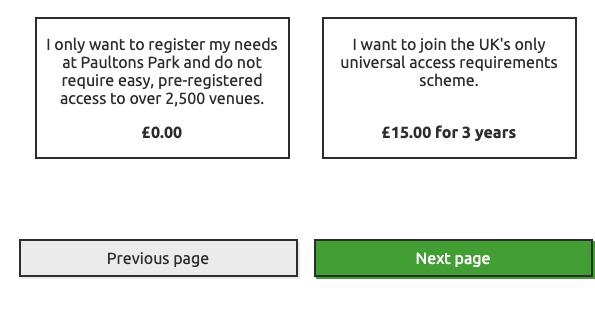
In fairness Merlin have always provided a free alternative to an Access card that is still issued by Nimbus but only valid for their parks. Paulton's and Blackpool continue to do the same, i expect others do too. For example:

During the application, you will have the choice to either register access requirements exclusively to Paultons Park, free of charge, or to upgrade to a full Access Card for £15 for 3 years which will be recognised at over 2000 venues throughout the UK and beyond.
 
In fairness Merlin have always provided a free alternative to an Access card that is still issued by Nimbus but only valid for their parks. Paulton's and Blackpool continue to do the same, i expect others do too. For example:

During the application, you will have the choice to either register access requirements exclusively to Paultons Park, free of charge, or to upgrade to a full Access Card for £15 for 3 years which will be recognised at over 2000 venues throughout the UK and beyond.
I fear you may have misidentified the intent of the "Free" alternative.

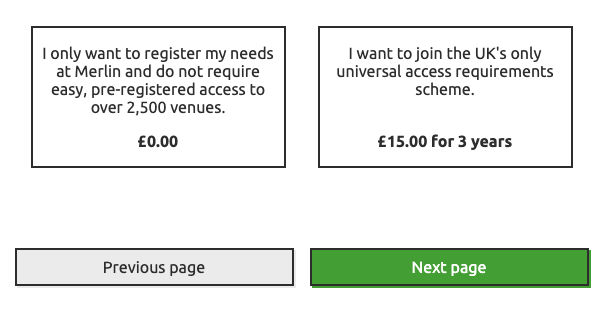
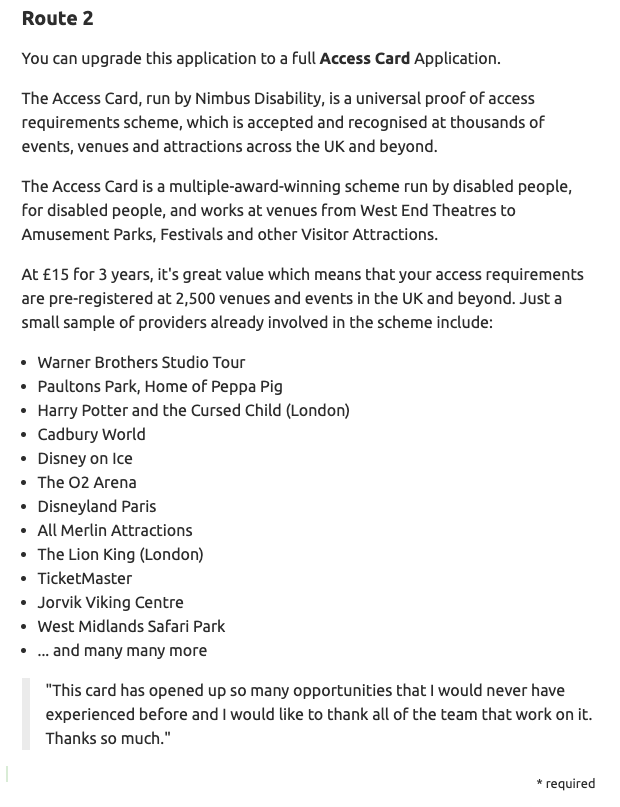
The free version is a customer acquisition tool, designed to upsell you. You're presented with the friction of a single park pass versus the convenience of a £15 universal "Access Card" which works at all of the other attractions which they will assess you for, individually, for free. It's a textbook upsell designed to drive conversions.

Their language choices aren't exactly subtle, and they will prompt you at every stage of the process to signup for the Access Card instead.

Screenshot-2026-02-09-at-17-03-11.png

Screenshot-2026-02-09-at-17-10-00.png

Screenshot-2026-02-09-at-17-10-17.png


I believe that they also offer to "upgrade" your Merlin Digital Access Pass to a full Access Card, for £15, in your acceptance email, so that you don't need to go through the assessment process again for other attractions.

We also shouldn't make the mistake of thinking the "Free" version generates zero revenue for Nimbus. Nothing in this world is truly free. If you aren't paying for the assessment, the park almost certainly is. Merlin isn't outsourcing their disability administration to Nimbus out of the goodness of their hearts, they are paying a service contract for it.

Nimbus wins every time. They either get the consumer's cash or the corporate client's cash.
 
Top