• ℹ️ Heads up...

    This is a popular topic that is fast moving Guest - before posting, please ensure that you check out the first post in the topic for a quick reminder of guidelines, and importantly a summary of the known facts and information so far. Thanks.

The "Look What I Made!" Topic.

Cheers! It is indeed a willow tree, still not back in place. Once I get the bulky stuff back in place, I will be able to start putting loads more little scenes of chaos in.

@Dan great stuff mate. As I said before, next year I will be lurking in your car port all night, in my plague reaper outfit.
 
  • Like
Reactions: Dan
I also built the following with Home Assistant for Halloween. The LED channels also run WLED.

When it gets dark on 31st Oct the lights play the default Halloween effect which is the middle strip with the red candle effect and the two side strips have a random strobe. When the doorbell is pressed it goes into the purple and orange wipe effect and when the door is opened it does a mega white strobe for a few seconds and then goes back to the red candle white strobe effect but there is a small white segment by the door for sweet visibility. When the door is shut the white segment becomes part of the random strobe effect the rest of that strip is doing.


From: https://youtube.com/shorts/F7cqPSMUzYw?si=tF45bU31JzUv-01w


I also added in a smoke machine and speaker


From: https://youtube.com/shorts/r6MucuVGhWA?si=0ZMrcqJSF5E9U6Ua


On the night I had 68 kids visit and a few stand outside and refuse to come in as it was too scary


Excellent! You've given me more inspiration for next year! WLED is on my to-do list but in reality I'll likely not get around to it.
 
Over the past two weeks or so, as some of you will already know (@Matt N and @Alix), I've been experimenting with "vibe coding" again.

For the uninitiated, vibe coding is where you ask the robots very nicely to build something with you. A fancier name is agentic assisted programming.

I do not consider myself a programmer, or a software developer, certainly not in the traditional sense. I understand systems, I can design systems, I have an instinct for what works and I can see patterns and innovative solutions to problems, but I cannot code (HTML and CSS not withstanding).

My early experiences vibe coding, with what became Gemini, were tantalisingly frustrating. It had the beginnings of being an incredibly powerful coding agent, but it required a lot of back and forth, a lot of hand holding and prompt precision which made it incredibly hard work and not really worth it.

Two years later it's very much a different pond.

The idea of building my own cred counting app has been at the back of my head for many years. Following the closure of Ridecount, I started thinking more seriously about it.

Ridecount closed as a result of increasingly stricter compliance regulations, GDPR followed by the Online Safety Act. Building a web service today is significantly more difficult than it was a decade ago. It also has the inherent problem of being overly reliant on an internet connection to work. A predominantly local first mobile application skirts around these issues.

No user accounts, no photo and video uploading, no messaging features, no online profiles. A copy of the park and attraction database would live on a web server, but it would also live within the app on your phone. Not only would this give the user privacy and fast response times, but it also meant that the app wouldn't be reliant on a live internet connection at a patchy Towers to log stuff.

I had originally envisioned making my app publicly available, but developer privacy policies on Google Play and the App Store have made me reconsider. For now, at least, it's very much a passion project for my own use. There are no signups, there is no early access list. I just wanted to share what it's possible to build, with widely accessible and mostly low cost AI tools.

Here's a look at Cred Count. An iOS and Android cred counting (and dispatch timing) application, built entirely with AI.


For those who are technically minded, I'm happy to answer any questions you may have.

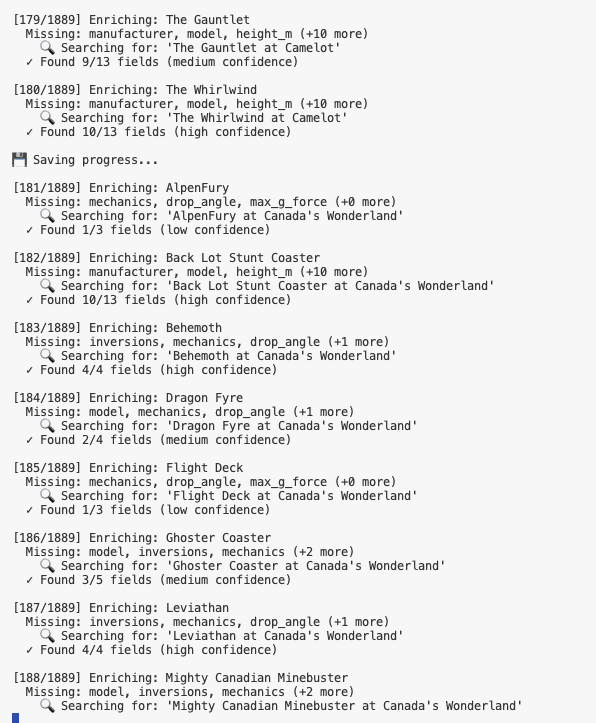
The database was assembled using agentic synthesis, based on a list of attractions and parks provided by @Leigh, instead of traditional web scraping. Whilst this approach was significantly more costly, it is generally considered more ethically and legally sound, although it is prone to hallucinations.

The app itself is programmed in Flutter, which technically allows for the dual native development of apps for both iOS and Android.

The "mother" database sits on my server, powered by PocketBase. The "child" databases are SQLite.

image.png
 
Top