
• ℹ️ Heads up...

    This is a popular topic that is fast moving Guest - before posting, please ensure that you check out the first post in the topic for a quick reminder of guidelines, and importantly a summary of the known facts and information so far. Thanks.

Incident on The Smiler 02/06/2015

Status
This topic has been locked. No further replies can be posted.
The HSE would be finding against themselves if they see the stall as the cause seen as they have for two years allowed the ride to operate knowing it can stall.

A lot of rides stall, B&M are pretty much the only manufacturer who avoid it completely. They will be looking at the block system, as that's what has failed.

The stall is relevant only as part of the sequence of events.
Dave, do you know for a fact that the HSE knew it stalled? Because unless somebody told them about the stalls, they probably wouldn't know about them - there is nothing in the reporting regulations RIDDOR that would require them to tell the HSE.

You are right in that the fact that a coaster stalls is not necessarily a major concern in itself. But when you design safety instrumented systems, you normally need to make assumptions about how often such safety systems will be required to operate - the so called 'demand rate'. Then, once you know the demand rate, you can work out how reliable the safety systems need to be to give a required safety integrity level. One thing the HSE will probe is what the design 'demand rate' for the ride was in terms of stalling - if it has stalled more often than anticipated, then there is a higher chance that any other safety systems may be deficient.

Way back in this thread, somebody mentioned the Swiss cheese model. You can think of the ride stalling as being the first layer in the swiss cheese - if it didn't stall, there couldn't have been an accident. The more often the ride stalls, the more 'holes' are in the first layer of the swiss cheese, and you need more rigorous safety levels in your remaining layers of cheese -or less holes - so that the gaps don't all line up. I suspect that is what has ben going on the previous few days - beefing up those other 'layers' so that they have less holes.
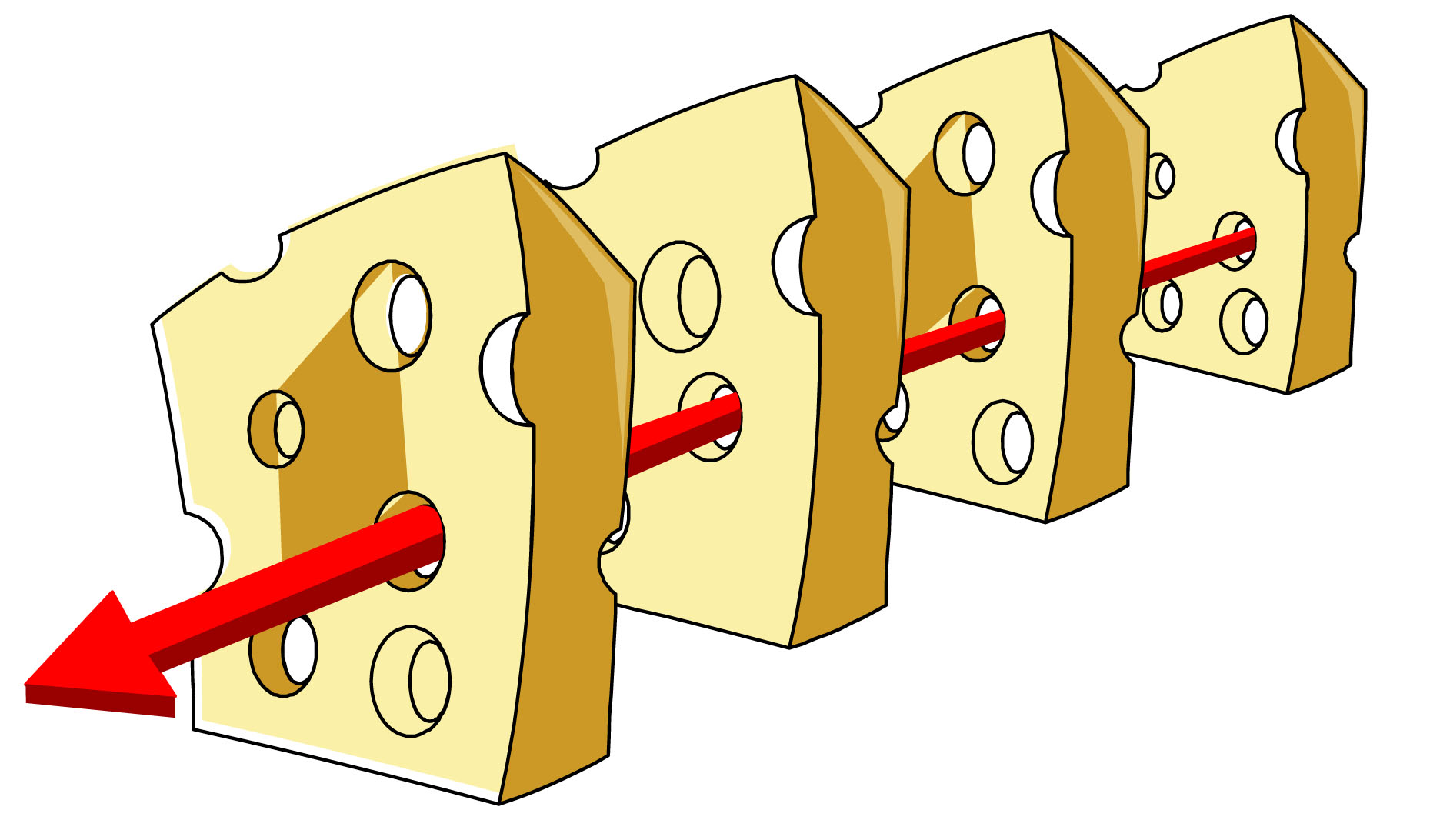
Swiss-Cheese-3.jpg
 
Way back in this thread, somebody mentioned the Swiss cheese model. You can think of the ride stalling as being the first layer in the swiss cheese - if it didn't stall, there couldn't have been an accident. The more often the ride stalls, the more 'holes' are in the first layer of the swiss cheese, and you need more rigorous safety levels in your remaining layers of cheese -or less holes - so that the gaps don't all line up. I suspect that is what has ben going on the previous few days - beefing up those other 'layers' so that they have less holes.

Interesting, I mentioned Dr. James Reason's 'Windows of Opportunity' theory a while back but never knew it is more widely known as the Swiss Cheese model!

Reading around, it's amazing the amount of people which seem believe that it's possible for things like rollercoasters to be 100% safe. As part of my work, I'm involved in a lot of health and safety films and the theme is the same, you cannot make anything 100% safe, you can only reduce the risk of an accident making it extremely unlikely to happen. The possibility is always there. That's life!
 
Just watching a video on YouTube of the ride testing (assume from prior to opening). The speed at which the train comes out of Batwing really is slow. I haven't been on the ride myself - was anything done to improve this after ride opening? Clearly it has stalled in the past but at the speed the train is seen coming out of the inversion in this video, I'm surprised it hasn't stalled more.


As other people have said. You would never expect Nemesis to even appear as though it was going to stall - even when empty and running in sub zero temperatures. Is there just a massive design flaw in this ride?
 
Just watching a video on YouTube of the ride testing (assume from prior to opening). The speed at which the train comes out of Batwing really is slow. I haven't been on the ride myself - was anything done to improve this after ride opening? Clearly it has stalled in the past but at the speed the train is seen coming out of the inversion in this video, I'm surprised it hasn't stalled more.


As other people have said. You would never expect Nemesis to even appear as though it was going to stall - even when empty and running in sub zero temperatures. Is there just a massive design flaw in this ride?


The reason it's running so slow is probably due to the ride not being fully worn in at that point, but also due to how slow the train ascends the first lift hill. It's noticeably slower than it is when open, and this is most certainly a contributing factor to the speed on the layout in that video.
 
The reason it's running so slow is probably due to the ride not being fully worn in at that point, but also due to how slow the train ascends the first lift hill. It's noticeably slower than it is when open, and this is most certainly a contributing factor to the speed on the layout in that video.
Sorry if it's a stupid question but can you define 'fully worn in'.
 
Are there any images of the damaged carriage once the people were evacuated? What was the pattern of damage - was it uniform across the whole of the front area or were certain areas weaker?
 
Last edited:
When I visited the park a few weeks ago the ride was running that slow. I recall commenting to my friend that it was just about making it through the inversions. Reminded me of one of those rides you build in RCT and the find it doesnt make it all the way around. I think there was definitely a slight miscalculation somewhere with the design.

Anyway, back on the subject of compensation, according to the Daily Fail, they could pay out milllions:

http://www.dailymail.co.uk/news/art...Towers-rollercoaster-crash-leg-amputated.html

Their lawer was on Radio 5 live today as I was driving home. He said that Alton Towers are making all the "right noises" at the moment in terms of accepting liability. He didnt want to say how much they could get, but said it would definitely be six figure sums. Also, I didnt know this but:

- Alton Towers have hand delivered letters to all 16 riders accepting liability
- Have contacted a private company specialising in rehabilitation after accidents like this (loss of limbs) and instructed them, if required, to work with the girl and others on the front row to assist them in any way they need.

However, as the lawyer also said, ultimately, the court case will be between Alton's insurer's and the lawyers, so who knows how it will play out. One things for sure, their policy is going up in price upon renewal!
 
@Pepper_Plant i have not seen any photos of after the event, however any photo would not show the orginal damage. As the fire service would of used equipment to free riders.

Also the two train contacted on a left had curve so more damage would of happened to the left front section of second train.
 
Decent piece on the incident on 5 Live last night, with an interview with Ned Hansen (founded Ride Centerline along with Alan Schilke). Starts at about 36 minutes in.

http://www.bbc.co.uk/programmes/b05xqb27

Sorry if it's a stupid question but can you define 'fully worn in'.

When we saw the first few test runs on The Smiler, they were very fast and it looked amazing. A day later, and it was suddenly running very slowly, almost stalling as seen on the video. I'm pretty sure it was down to wheel compounds, the TPW video above shows the train running brand new wheels, to test the limits of the coaster (and it was very close to the stalling limit there).
 
Dave, do you know for a fact that the HSE knew it stalled? Because unless somebody told them about the stalls, they probably wouldn't know about them - there is nothing in the reporting regulations RIDDOR that would require them to tell the HSE.

You are right in that the fact that a coaster stalls is not necessarily a major concern in itself. But when you design safety instrumented systems, you normally need to make assumptions about how often such safety systems will be required to operate - the so called 'demand rate'. Then, once you know the demand rate, you can work out how reliable the safety systems need to be to give a required safety integrity level. One thing the HSE will probe is what the design 'demand rate' for the ride was in terms of stalling - if it has stalled more often than anticipated, then there is a higher chance that any other safety systems may be deficient.

Way back in this thread, somebody mentioned the Swiss cheese model. You can think of the ride stalling as being the first layer in the swiss cheese - if it didn't stall, there couldn't have been an accident. The more often the ride stalls, the more 'holes' are in the first layer of the swiss cheese, and you need more rigorous safety levels in your remaining layers of cheese -or less holes - so that the gaps don't all line up. I suspect that is what has ben going on the previous few days - beefing up those other 'layers' so that they have less holes.

Swiss-Cheese-3.jpg

The first stall occurred during ADIPS testing, so they would have to be fairly blind not to notice. The block system on most coasters engages most days, even B&M are prone to "phantom trains" where the ride detects a train that doesn't exist so most manufacturers make the block system very robust.

The other thing to bear in mind is the mechanisms for stopping the ride if a block isn't clear on The Smiler are mechanisms that are operating anyway (lift hills, brakes) as part of normal operations, so what you don't want to fail is the system monitoring, but that shouldn't fail, stall or not as again it forms part of daily operations.
 
Last edited:
I don't understand why people are defending the Smiler in relation to it stalling. Yes, it's a common occurrence on roller coasters, BUT they are theoretically designed to NOT stall. So yes, it was a design flaw.

Yes, it had been a while since stalling, and steps had been taken to reduce the chances of stalling, but given that the batwing is the location of every single stall since construction completed, it WAS a design flaw.

BUT it was not this design flaw that caused the crash, but a failure of the block system
 
All rollercoasters have the potential to stall. Riddler's Revenege at SFMM stalled at the beginning of the season once, and earlier this year The Incredible Hulk at IoA had an incident (so B&M aren't immune to problems):
http://www.wptv.com/news/state/riders-rescued-from-stuck-hulk-roller-coaster-at-universal-orlando

A bird could fly in to a wheel, plastic/paper bag blow up in to the track or a wheel tyre burst. Any similar incident could jam the wheelset and bring the train to a halt mid-circuit.
 
The first stall occurred during ADIPS testing, so they would have to be fairly blind not to notice. The block system on most coasters engages most days, even B&M are prone to "phantom trains" where the ride detects a train that doesn't exist so most manufacturers make the block system very robust.

The other thing to bear in mind is the mechanisms for stopping the ride if a block isn't clear on The Smiler are mechanisms that are operating anyway (lift hills, brakes) as part of normal operations, so what you don't want to fail is the system monitoring, but that shouldn't fail, stall or not as again it forms part of daily operations.
But would the HSE be present during ADIPS testing (whatever that is - sorry, don't know what the terminology is!)? I would be very surprised if that was the case - please correct me if I'm wrong, and you know something definite, but I would think their presence would be very unlikely.

HSE doesn't need to witness tests and give approval for operation (in fact they positively stay away from such things - they never want to be seen to be part of any QA process - and it is because of situations like this where people can turn around and say 'you were there when we tested it and you never raised any issues then'). Furthermore, the HSE just doesn't have the resources, especially nowadays, to do much more than incident investigations outside of major hazards sites like chemical plants and offshore. Despite what the general public think, there isn't an army of HSE inspectors with clipboards waiting to pounce.
 
No offence to those who commented, but there are a few inaccuracies about how rollercoasters work being discussed.

@
phildenholm Increasing the lift hill speed will just get the train to the top faster, it bears no relation to the speed of the train on the track. Think of a marble run, if you place a marble at the top it will roll down, if it encounters a hill it doesn't have the momentum to get up then it stalls, it doesn't matter how fast you push the marble to the top of the hill it will still roll down a the same speed.

@Nemesis94 all good reasons why a stall could happen, except the burst tyre, I am not aware of any coaster with inflatable wheels, they are solid plastic or rubber usually (different compounds of plastic give different speed).

I am no expert so I am sure there are engineers that know a lot more!http://www.towersstreet.com/talk/members/phildenholm.1830/
 
But would the HSE be present during ADIPS testing (whatever that is - sorry, don't know what the terminology is!)? I would be very surprised if that was the case - please correct me if I'm wrong, and you know something definite, but I would think their presence would be very unlikely.

HSE doesn't need to witness tests and give approval for operation (in fact they positively stay away from such things - they never want to be seen to be part of any QA process - and it is because of situations like this where people can turn around and say 'you were there when we tested it and you never raised any issues then'). Furthermore, the HSE just doesn't have the resources, especially nowadays, to do much more than incident investigations outside of major hazards sites like chemical plants and offshore. Despite what the general public think, there isn't an army of HSE inspectors with clipboards waiting to pounce.

ADIPS safety test amusement rides, they are not part of the HSE but they work under their accreditation. All Rides get ADIPS check before their opened and annually.

I don't understand why people are defending the Smiler in relation to it stalling. Yes, it's a common occurrence on roller coasters, BUT they are theoretically designed to NOT stall. So yes, it was a design flaw.

Yes, it had been a while since stalling, and steps had been taken to reduce the chances of stalling, but given that the batwing is the location of every single stall since construction completed, it WAS a design flaw.

BUT it was not this design flaw that caused the crash, but a failure of the block system

No one is defending the ride stalling, it shows how shoddy the design was. That said people are fixating on the stall when to me the worrying feature is the block failure, because block rules should be absolute on all coasters. Stalls happen around the world all the time (Most never get reported), we therefore need to be sure the block system can be trusted.
 
Indeed, HSE are very limited in their resources now. I was only speaking to someone about this at work the other day (I work in business regaultion) and in theory HSE, as the UK's national H&S body, are meant to audit out public safety department. However this does not happen, they do not have the resources. The vast majority of their time is spent on incident investigations which take up a lot of time. Taking something to court is a very lengthy process.

Anyway, regarding the stall, I think it is wrong to say that the stall is irrelevant. The stall was not the main cause of the incident, however it was very relevent to what did happen. If there was no stall there would have been no crash. The main cause was the block failure and why a train was allowed to be sent over the lift with the train ahead not clearing the block.

Now stalls can happen on any coaster, of course you don't want them to but it's just one of those things. The point here though is that The Smiler has a history of stalling, far more so than other coasters. This was either the third or fourth time it had stalled at this point. I believe this is the first time it has stalled during 'normal operation' though (i.e. not in testing/morning testing).

So with the ride laible to stalling, I would imagine one of the many things that the HSE will look at is what measures are in place for if a train does stall, especially if it was to happen with the ride open to the public. It appears that the stalled train was not identified by the ride system or staff (although the ride system clearly had initally worked out that the train had not cleared the block). I fully expect Towers to add proxy sensors to the batwing so that if a train does stall in the future the train will be detected by the ride system, even if the whole system is fully reset to 'clear' the blocks. There will also be a camera added looking directly at that part of the track I would imagine, seeing as there doesn't seem to be at present. Both of these modifications should, in theory, mitigate against a similar incident.

As I say though, the HSE will be thorough and look into everything. This will just be one of many parts of the investigation.

:)
 
There are coasters out there that beat Smilers stall rate. The stall as said is relevant in the chain of events but its the block failure that worries me. Stalls are an accepted risk of coaster operation. Block failures should NEVER happen.

The incident at LWV that killed someone was a block failure allowing a car to crash into a stalled car and the failure was pinned down to errors in the block system. The stall was barely mentioned.
 
There are coasters out there that beat Smilers stall rate. The stall as said is relevant in the chain of events but its the block failure that worries me. Stalls are an accepted risk of coaster operation. Block failures should NEVER happen.

The incident at LWV that killed someone was a block failure allowing a car to crash into a stalled car and the failure was pinned down to errors in the block system. The stall was barely mentioned.

I agree, but as we know the block system did it's job initially in stopping the train at the top of lift 1. It was there for at least 5 minutes. If the ride randomly restarted itself then there was something very badly wrong with the block system. Now I assume all blocks can be manually reset, otherwise a coaster would never get going again after a stall. If, and I do emphasises the if, something like this happened there would have been a clear failure by both the ride system and staff to identify a stalled train (as well as a procedural failure). If a stalled train had been identified you would imagine that the ride would immediately have been E-stopped, even after the block had done it's job, and a standard lift-evac would take place.

:)
 
Status
This topic has been locked. No further replies can be posted.
Top